Khóa học
IELTS Online
IELTS Online
Giảm đến 18%
Đăng ký ngay
Mục lục [Ẩn]
Đề thi thật là một cách hiệu quả giúp bạn tăng band điểm nhanh. Bài viết này, bạn sẽ cùng tìm hiểu và chinh phục đề thi IELTS Reading “New perspectives on food production”, bao gồm toàn bộ đề bài, câu hỏi, đáp án chi tiết và phần giải thích rõ ràng cho từng câu. Đây là tài liệu ôn luyện IELTS chất lượng giúp bạn củng cố kỹ năng đọc hiểu, mở rộng vốn từ học thuật và rèn chiến thuật làm bài hiệu quả, từ đó tăng band điểm nhanh chóng và tự tin hơn khi bước vào kỳ thi chính thức.
New perspectives on food production
Solving the food problem requires scientific progress, but also an understanding of social context and cultures
Is new technology needed for global food production?
The Food and Agriculture Organization of the United Nations notes that domestic prices of staple food are continuing to increase, leading to a rise in the number of people worldwide who are chronically underfed. According to Erik Millstone, a food and agriculture researcher funded by the Economic and Social Research Council (ESRC), the natural science community tends to view world hunger as if it were a problem that could be solved simply by increasing total production. But, he says, 'Most people who are chronically hungry are so not because of the scarcity of food but because they are unable to afford what is available. In addition, the food trade is so globalised that food is often exported from areas where people are hungry and sent to countries where people already have sufficient.'
Millstone believes the problem can only be solved by changing the conditions for poor subsistence farmers and providing the support they need to grow more food. And that is not enough on its own-they also have to have facilities for storing it so that their food can be kept safe and in good condition until it is needed. But, he adds, increasing productivity through technology is not the answer. An example is the new genetically-engineered varieties of high-performance maize. The problem with these new varieties is that if you save seed and plant it again next year, its vigour has diminished. Most North American and European farmers can afford to get new seed every year; poor farmers cannot, so they need traditional varieties whose seed can be saved and replanted. Giving farmers access to credit also doesn't help; it adds risk. 'Poor farmers should not be thought of as entrepreneurs looking to invest their money. They are looking to diminish their risk.' Ultimately, he concludes, 'Instead of devoting resources to research for intensifying commercial farming, we should devote them to enhancing the techniques available to subsistence farmers, and to developing appropriate tools for them to use, because their need is the greatest. Increasing their productivity will do more to enhance food security for those who are hungry than anything else we can do.'
Looking for local solutions in the UK
In contrast to Millstone, Gareth Edwrds-jones a professor of agriculture and land use at the University of Bangor in Wales, focuses on food production in the UK. In recent years 'local food' has become fashionable in the UK without any real understanding of the issues involved. First and foremost, it is necessary to define more precisely what is meant by 'local' Is bread bought in England from an English bakery "local if the wheat it is made from was grown in Canada? Funded through the Rural Economy and Land Use Programme, Edwards Jones is studying people's perceptions of" localness' and seeking to establish whether there is any science behind the popular belief that "local is better'.
His work involves studying the carbon footprint* of foods grown in different areas of the UK, as well as such common sources of supply as Spain, Kenya, and Uganda. He has made some surprising discoveries. Which has the lower carbon footprint: sugar made from sugar cane grown in Africa, or from sugar beet flown in from Europe? The answer is sugar from sugar cane in Africa. Similarly, trucking vegetables in from Spain may have a smaller carbon footprint than growing them locally in the UK-because growing them locally requires adding all the emissions of running a heated greenhouse.
And, he asks, how far down the life cycle should you go? He discovered early in his research that the methods used to prepare foods to be eaten can have a huge impact; boiling potatoes accounts for fully half their carbon footprint. Ultimately, it’s a mistake to look at just one part of the food chain. You could have a policy where you’re going to really pressure farmers to try to get emissions down, but decarbonising fuel and electricity is a much more effective method of protecting the environment, he says.
Another of Edwards-Jones’s research projects involved visiting farm workers in each of the above countries to assess their health and well-being. ‘We found that farm workers in Kenya had better physical and mental health than the average Kenyan,’ he says, attributing the difference to both better income and to the benefits-housing, schools, medical care provided by their large corporate employers. He finds it ironic that after years of ‘trade not aid’ all of a sudden people are starting to say the UK shouldn’t be importing food from Africa.
The other problem with insisting on locally grown food, he says, is that the UK is not suited to growing most fruits and vegetables-the key elements in a healthy diet. These crops need our best land-which means demoting other crops that do grow well in the UK to lower quality land. ‘There’s a domino effect so that increasing self sufficiency may, from an environmental perspective, be quite bad,’ he says.
Questions 1-8
Complete the notes below.
Choose ONE WORD ONLY from the passage for each answer.
Write your answers in boxes 1-8 on your answer sheet.
The problem of world hunger
CAUSE
Some scientists see world hunger as due to a general 1. ________________ of food.
But it may be because:
hungry people cannot 2. ________________
food is not available because it has been 3. ________________
SOLUTION
provide support for subsistence farmers in growing and 4. ________________ their food
ADDITIONAL RECOMMENDATIONS
don’t use 5. ________________ to increase food production, e.g. 6. ________________ varieties of maize are better for poor farmers as the seed can be replanted
don’t provide opportunities for farmers to have 7. ________________ - too risky
don’t do research into intensifying commercial farming
do improve techniques and 8. ________________ available to subsistence farmers
Questions 9-13
Do the following statements agree with the information given in Reading Passage 1?
In boxes 9-13 on your answer sheet, write
TRUE if the statement agrees with the information
FALSE if the statement contradicts the information
NOT GIVEN if there is no information on this
9. Importing sugar to the UK from other parts of Europe is less environmentally harmful than importing sugar from Africa.
10. The way in which some foods are cooked may affect their impact on the environment.
11. The best way to reduce harm to the environment is to oblige farmers to use more environmentally friendly farming methods.
12. Imports of food to the UK from African countries such as Kenya have fallen recently.
13. Growing fruit and vegetables is better for the environment than raising animals for food.
>>> XEM THÊM:
Cách làm Multiple Choice trong IELTS Reading ẵm trọn điểm tối đa
Cách làm Matching Information trong IELTS Reading “ẵm trọn” điểm cao
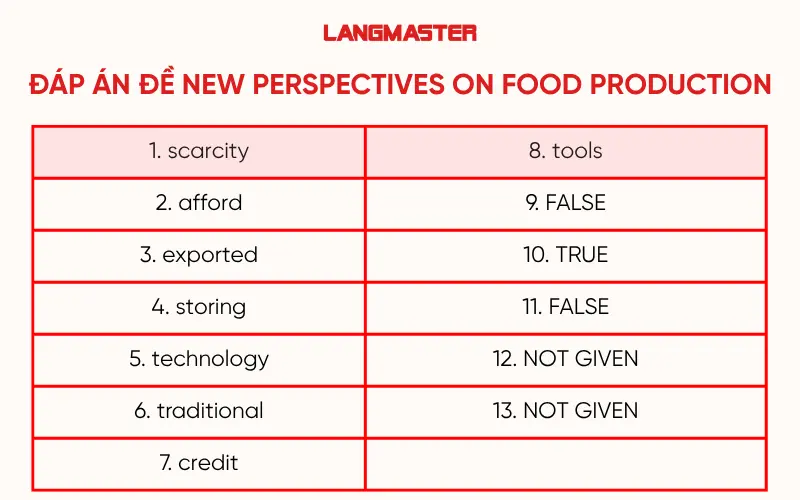
Dưới đây là bảng đáp án để đối chiếu:
|
1. scarcity |
8. tools |
|
2. afford |
9. FALSE |
|
3. exported |
10. TRUE |
|
4. storing |
11. FALSE |
|
5. technology |
12. NOT GIVEN |
|
6. traditional |
13. NOT GIVEN |
|
7. credit |
Đáp án chi tiết 1-8
1. scarcity → Một số nhà khoa học cho rằng nạn đói là do thiếu hụt thực phẩm
“Most people who are chronically hungry are so not because of the scarcity of food but because they are unable to afford what is available.”
→ Từ scarcity (sự khan hiếm) diễn tả quan điểm của một số nhà khoa học cho rằng đói nghèo là do thiếu thức ăn.
2. afford → Người nghèo không đủ tiền để mua thực phẩm
“…because they are unable to afford what is available.”
→ Unable to afford cho thấy nguyên nhân thực sự là không có khả năng chi trả, chứ không phải thiếu nguồn cung.
3. exported → Thực phẩm bị xuất khẩu khỏi vùng có nạn đói
“…food is often exported from areas where people are hungry and sent to countries where people already have sufficient.”
→ Exported nghĩa là lương thực bị đưa ra khỏi nơi đói nghèo, tạo nên sự mất cân bằng nguồn cung.
4. storing → Cần hỗ trợ nông dân lưu trữ lương thực
“…they also have to have facilities for storing it so that their food can be kept safe…”
→ Storing có nghĩa là bảo quản, dự trữ thực phẩm để giữ được chất lượng lâu dài.
5. technology → Không nên dùng công nghệ để tăng năng suất
“…increasing productivity through technology is not the answer.”
→ Tác giả cho rằng việc dựa vào công nghệ hiện đại không phải giải pháp cho vấn đề an ninh lương thực.
6. traditional → Giống cây trồng truyền thống phù hợp hơn với nông dân nghèo
“…they need traditional varieties whose seed can be saved and replanted.”
→ Traditional varieties là giống truyền thống, có thể giữ hạt và trồng lại – giúp nông dân tiết kiệm chi phí.
7. credit → Cho vay tín dụng làm tăng rủi ro cho nông dân
“Giving farmers access to credit also doesn’t help; it adds risk.”
→ Credit ở đây nghĩa là khoản vay, nhưng điều này làm tăng rủi ro tài chính cho nông dân.
8. tools → Nên phát triển công cụ phù hợp cho nông dân tự cung
“…developing appropriate tools for them to use…”
→ Tools (công cụ) giúp nâng cao kỹ thuật và năng suất cho nông dân tự cung tự cấp.
Đáp án chi tiết 9-13
9. Importing sugar to the UK from other parts of Europe is less environmentally harmful than importing sugar from Africa.
Đoạn “Which has the lower carbon footprint: sugar made from sugar cane grown in Africa, or from sugar beet flown in from Europe? The answer is sugar from sugar cane in Africa.” → Nghĩa là đường làm từ mía ở châu Phi có dấu chân carbon thấp hơn (ít gây hại môi trường hơn) so với đường củ cải đường từ châu Âu.
→ Câu hỏi nói ngược lại (rằng châu Âu ít gây hại hơn) → FALSE.
10. The way in which some foods are cooked may affect their impact on the environment.
Đoạn: “He discovered early in his research that the methods used to prepare foods to be eaten can have a huge impact; boiling potatoes accounts for fully half their carbon footprint.” → Ông phát hiện ra rằng cách chế biến thực phẩm, ví dụ như luộc khoai tây, có thể chiếm một nửa lượng khí thải carbon.
→ Điều này chứng minh cách nấu ăn ảnh hưởng đến tác động môi trường → TRUE.
11. The best way to reduce harm to the environment is to oblige farmers to use more environmentally friendly farming methods.
Đoạn: “You could have a policy where you’re going to really pressure farmers to try to get emissions down, but decarbonising fuel and electricity is a much more effective method of protecting the environment.” → Nghĩa là ép nông dân giảm khí thải cũng được, nhưng giảm carbon trong nhiên liệu và điện vẫn là phương pháp hiệu quả hơn nhiều.
→ Vì vậy, câu hỏi nói rằng ép nông dân là cách tốt nhất → FALSE.
12. Imports of food to the UK from African countries such as Kenya have fallen recently.
Đoạn: “He finds it ironic that after years of ‘trade not aid’ all of a sudden people are starting to say the UK shouldn’t be importing food from Africa.” → Câu này chỉ nói rằng mọi người bắt đầu phản đối việc nhập khẩu thực phẩm từ châu Phi, chứ không có thông tin nào về việc lượng nhập khẩu thực tế giảm hay tăng.
→ Không đủ thông tin để kết luận → NOT GIVEN.
13. Growing fruit and vegetables is better for the environment than raising animals for food.
Đoạn: “The other problem with insisting on locally grown food, he says, is that the UK is not suited to growing most fruits and vegetables - the key elements in a healthy diet. These crops need our best land... increasing self-sufficiency may, from an environmental perspective, be quite bad.” → Đoạn này chỉ nói rằng Anh không phù hợp để trồng rau quả, và việc cố tự trồng có thể gây hại cho môi trường.
→ Không có so sánh nào với việc nuôi động vật → NOT GIVEN.
>>> XEM THÊM:
Giải đề IELTS Reading: Video Games and Violence [Full answers]
How Tennis Rackets Have Changed IELTS Reading: Cam 19 Test 1 Passage 1
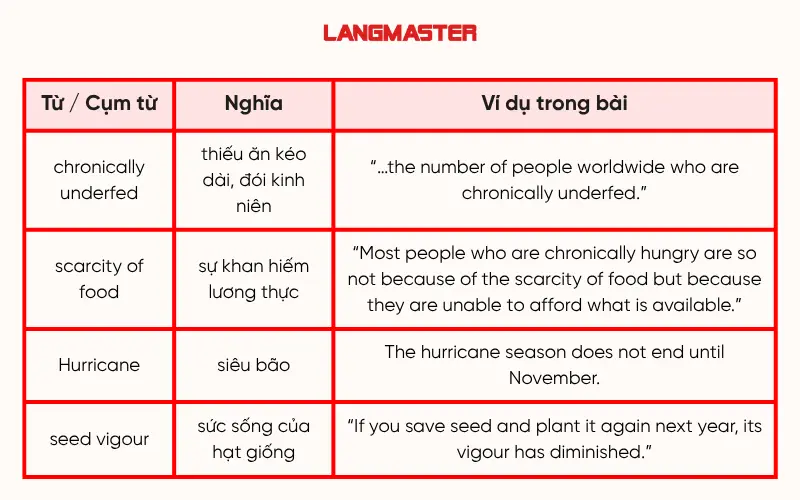
Khi chuẩn bị cho kỳ thi IELTS Reading, việc phát triển vốn từ vựng theo kế hoạch học tập rõ ràng chính là chìa khóa để nâng cao band điểm. Dưới đây là tổng hợp từ vựng quan trong trong bài đọc “New perspectives on food production” giúp bạn tăng tốc độ đọc hiểu, cải thiện kỹ năng phân tích và từng bước nâng cao kết quả khi làm bài thi thật.
|
Từ / Cụm từ |
Nghĩa |
Ví dụ trong bài |
|
chronically underfed |
thiếu ăn kéo dài, đói kinh niên |
“…the number of people worldwide who are chronically underfed.” |
|
scarcity of food |
sự khan hiếm lương thực |
“Most people who are chronically hungry are so not because of the scarcity of food but because they are unable to afford what is available.” |
|
globalised food trade |
thương mại lương thực toàn cầu hóa |
“...the food trade is so globalised that food is often exported from areas where people are hungry…” |
|
subsistence farmers |
nông dân tự cung tự cấp |
“The problem can only be solved by changing the conditions for poor subsistence farmers.” |
|
genetically-engineered varieties |
giống cây trồng biến đổi gen |
“An example is the new genetically-engineered varieties of high-performance maize.” |
|
seed vigour |
sức sống của hạt giống |
“If you save seed and plant it again next year, its vigour has diminished.” |
|
access to credit |
khả năng tiếp cận tín dụng |
“Giving farmers access to credit also doesn't help; it adds risk.” |
|
commercial farming |
nông nghiệp thương mại |
“Instead of devoting resources to research for intensifying commercial farming…” |
|
carbon footprint |
lượng khí thải carbon (dấu chân carbon) |
“He is studying the carbon footprint of foods grown in different areas of the UK.” |
|
heated greenhouse |
nhà kính được sưởi ấm |
“Growing them locally requires adding all the emissions of running a heated greenhouse.” |
|
life cycle |
vòng đời (của sản phẩm, quy trình) |
“He asks, how far down the life cycle should you go?” |
|
policy |
chính sách |
“You could have a policy where you pressure farmers to get emissions down…” |
|
decarbonising fuel |
khử carbon trong nhiên liệu |
“...but decarbonising fuel and electricity is a much more effective method.” |
|
trade not aid |
thương mại thay vì viện trợ |
“He finds it ironic that after years of ‘trade not aid’ people are saying the UK shouldn’t import food from Africa.” |
|
self-sufficiency |
tự cung tự cấp |
“Increasing self-sufficiency may, from an environmental perspective, be quite bad.” |
>>> XEM THÊM:
Khi thực hành với đề IELTS Reading “New perspectives on food production”, học viên thường gặp thách thức trong việc phân tích dạng bài và vận dụng từ vựng học thuật một cách hiệu quả. Để tối ưu kết quả, việc xây dựng lộ trình ôn tập khoa học kết hợp cùng sự hướng dẫn từ giáo viên giàu kinh nghiệm sẽ mang lại lợi ích rõ rệt.
Để đáp ứng nhu cầu, Langmaster xây dựng các khóa học IELTS online với lộ trình cá nhân hóa. Học viên sẽ được giảng viên theo sát, chỉ ra lỗi sai ngay lập tức trong vòng 24 giờ và hướng dẫn phương pháp học tập tối ưu để tiến bộ nhanh chóng hơn.

Tại Langmaster học viên được:
Coaching 1 - 1 với chuyên gia: Học viên được kèm riêng để khắc phục điểm yếu, phân bổ thời gian thi chi tiết, tập trung rèn kỹ năng chưa vững và rút ngắn lộ trình nâng band.
Sĩ số lớp nhỏ, 7 - 10 học viên: Giáo viên theo sát từng bạn, nhiều cơ hội trao đổi và nhận phản hồi chi tiết.
Giáo viên 7.5+ IELTS: Chấm chữa bài trong 24 giờ, giúp bạn cải thiện nhanh chóng.
Lộ trình học cá nhân hóa: Thiết kế dựa trên trình độ đầu vào và mục tiêu điểm số, kèm báo cáo tiến bộ hàng tháng.
Thi thử định kỳ: Mô phỏng áp lực thi thật, phân tích điểm mạnh - yếu để điều chỉnh chiến lược học.
Cam kết đầu ra, học lại miễn phí: Đảm bảo kết quả, giảm thiểu rủi ro “học xong vẫn chưa đạt mục tiêu”.
Học online tiện lợi, chất lượng như offline: Có bản ghi để xem lại, linh hoạt, tiết kiệm thời gian, chi phí.
Hệ sinh thái học tập toàn diện: Tài liệu chuẩn, bài tập online, cộng đồng học viên và cố vấn luôn đồng hành.
Đăng ký học thử IELTS Online miễn phí ngay hôm nay để trải nghiệm lớp học thực tế, kiểm tra trình độ và nhận lộ trình học tập hiệu quả, giúp bạn thành thạo kỹ năng IELTS Writing và chinh phục mục tiêu IELTS!
Việc ôn luyện với đề IELTS Reading “New perspectives on food production” không chỉ giúp bạn củng cố kiến thức mà còn rèn luyện khả năng phân tích và tư duy logic trong từng dạng câu hỏi. Hãy duy trì luyện tập đều đặn mỗi ngày để đạt kết quả tốt nhất, chúc bạn học tập hiệu quả và chinh phục mục tiêu IELTS như mong muốn!
Các dạng bài phổ biến và tiêu chí chấm điểm IELTS Reading chi tiết nhất: Multiple Choice, Matching Information, Matching Headings,... và hướng dẫn chiến lược làm bài hiệu quả
Những sai lầm khi luyện IELTS Reading bao gồm: dịch từng từ, đọc hết cả bài, không đọc câu hỏi trước, không quản lý thời gian, không nắm vững kỹ năng paraphrase, viết sai chính tả
![Giải đề IELTS Reading: A brief history of humans and food [full answers]](https://langmaster.edu.vn/storage/images/2025/09/20/a-brief-history-of-humans-and-food-ielts-reading-answers.webp)
Giải đề thi IELTS Reading “A brief history of humans and food” kèm full đề thi thật, câu hỏi, đáp án, giải thích chi tiết, và từ vựng cần lưu ý khi làm bài.
Tổng hợp IELTS Reading tips hay nhất giúp bạn đọc nhanh, nắm ý chính và xử lý thông tin chính xác, tự tin đạt điểm cao trong kỳ thi IELTS.
![Giải đề IELTS Reading: The importance of law [Full answers]](https://langmaster.edu.vn/storage/images/2025/09/22/55.webp)
Giải đề IELTS Reading “The importance of law” kèm đáp án chi tiết, từ vựng quan trọng và bí quyết luyện thi hiệu quả để nâng cao band điểm.



Hơn 16 năm kinh nghiệm, đào tạo thành công 800.000+ học viên
Phương pháp giảng dạy hiện đại, học viên tiến bộ rõ rệt
Lộ trình học chuẩn quốc tế, phù hợp với nhu cầu thực tiễn
Giáo viên đạt chuẩn Quốc tế với chất lượng top đầu thị trường, giàu kinh nghiệm
Học online linh hoạt, cam kết đầu ra bằng văn bản

![Giải đề IELTS Reading Left or Right [FULL ANSWER]](https://langmaster.edu.vn/storage/uploads/original/2025/10/18/left-or-right-ielts-reading-answers.png)
![Giải đề IELTS Reading Growing more for less [FULL ANSWER]](https://langmaster.edu.vn/storage/uploads/original/2025/10/22/growing-more-for-less-ielts-reading-answers.png)